

Accessible transportation is vitally important for the lives of people with mobility impairments, and we argue that taxi services are part of this solution. This essay portrays and reflects on the experiences of wheelchair and disabled customers of taxi services. This complementary insight into the lifeworld of people with mobility impairments in their local area underlines the real-world impact of not providing better access to viable taxi services. Our participants reported experiencing material and non-material consequences of insufficient and absent taxi services. These lesser alternatives contributed to disempowerment and various negative personal and societal spatial, economic, and social issues.
The Equality Act makes it illegal for taxi services to discriminate against people with mobility impairments, and it is now illegal to refuse to carry a wheelchair user. However, the quality of service still needs to improve. Little is known about how wheelchair users currently experience the taxi services provided to them. Understanding these experiences will help identify potential solutions that can improve the lives of a section of the disabled community. Before considering the broader context, this essay will look at taxi services in a small town, a touch smaller than others. We consider how lack of area size affects taxi services and illustrate the importance of an inclusive approach to understanding the issue. In doing so, we further highlight why inaccessible taxis and poor infrastructure matter. The essay is structured as follows. The next section provides an overview of the law, practice, and recent debate, including a contemporary legislative change. The following section details how we conducted our research and introduces the towns that we studied. In the next section, we draw on the experiences of two wheelchair users to illustrate some of the continuing challenges that their local taxi services present. We take a step back in the following section to examine disability policies and regulations. Establishing that these fall short on both a micro and a macro level, it is time to require service providers to deliver the supply of, and the routes for, public and private means of transportation that are both equivalent and adequate. The final section considers the views of the disabled participants we were able to follow up with and the types of solutions they told us they believe might improve access, primarily for public transport but also for private transportation.
Challenges Faced by Wheelchair and Disabled Customers
Accessing taxi services is impossible. There are many problems for wheelchair and disabled customers who want to book a taxi. First, there are not enough vehicles around the city that are accessible. If individuals call a taxi company, they cannot book one with access to a wheelchair. Even if there are wheelchair-accessible vehicles, drivers refuse to pick up requests from disabled persons. They expect an extra cost from customers, which is actually illegal. Many wheelchair users are at risk during the cold at night. These individuals use their wheelchairs to commute to work every single day. They try to call for accessible taxis but can’t get one. The taxi company told them to wait 40 minutes or even 2.5 hours, but no taxi was coming. Consequently, they have to stay late, making it very cold or freezing outside. In some cities, there is no guarantee that you will get taxis, even if the booking rates are quite high.
Beyond needing a little break from time to time, people with disabilities must be strategic about travel to get ahead of the crowds packing in and out of trains or buses — trains have a two-person maximum for wheelchair users. If you end up waiting in line, it could be more challenging to get a carriage reserved for passengers with disabilities. For wheelchair and disabled customers, travelling around the city is already tough, complicated, and dangerous enough, but the biggest evidence of all is the emotional and mental tension. They make their journey stressful and risk getting depressed. Risking their physical health is even more stressful. Disabled people know they can no longer rely on taxi services when they desperately need them, so getting on a bus or a public vehicle is the only alternative. However, they can also be a potential cause of discrimination and violence. Knowing they face these challenges makes them feel lost, isolated, and terrified. It can take a lot of time, a great deal of complicated mental pressure, and an enormous burden.
Technological Solutions for Improved Accessibility
Improving Accessibility in Taxi Services
Recently, many apps have been developed to book accessible vehicles or advertise one’s services as a driver. These apps aim to match customers with the appropriate service or vehicle through an accessible platform. These apps mainly focus on providing a list of drivers or available vehicles near your location, which is possible in part due to GPS tracking technology that captures driver data to produce a list based on who is available at that moment. This same principle has been applied to lodge bookings for accessible accommodation at a hotel chain in collaboration with a charity.
Other apps are aimed at pedestrians with mobility issues, showing locations of public facilities and shops that offer accessible facilities, such as disabled toilets. Though not specific to taxis, this app genre demonstrates potential application within the taxi industry. Some services also factor in a pre-planned wait time and offer the option to track the vehicle from their app. They also advertise accessible vehicles and any unique benefits these services offer. The apps available for pre-booking an accessible vehicle also vary in the level of service they offer paying customers. Many offer the option for different payment methods and the ability to leave feedback, whether this is on the driver service provided or both. Through these affordances, user reviews and ratings can be accessed, apart from directly asking in-app for a rating of the driver and the user’s experience. Another area of assistive technology and vehicle manufacture that may potentially address accessibility issues in private hire vehicles is the introduction of new vehicle designs, including but not limited to WAV.
Best Practices and Case Studies
Case studies and best practices
Toronto, New York City, Leeds, Los Angeles, Kyoto, Portland, Boston, Ottawa, Lexington, Grand Rapids, and Philadelphia boast successful accessible taxi systems. Each city’s strategies and programs may have common themes, but no two systems are exactly alike. The differences in each initiative offer everyone interested in improving services for wheelchair customers insight into what might work – and what might not – for their communities. Provider and customer involvement is crucial in designing and operating an accessible taxi service. Half of the listed locations have placed an involved body like a commission, committee, or task force in charge of setting service policies and monitoring operations to ensure delivery meets the requirements of people with disabilities.
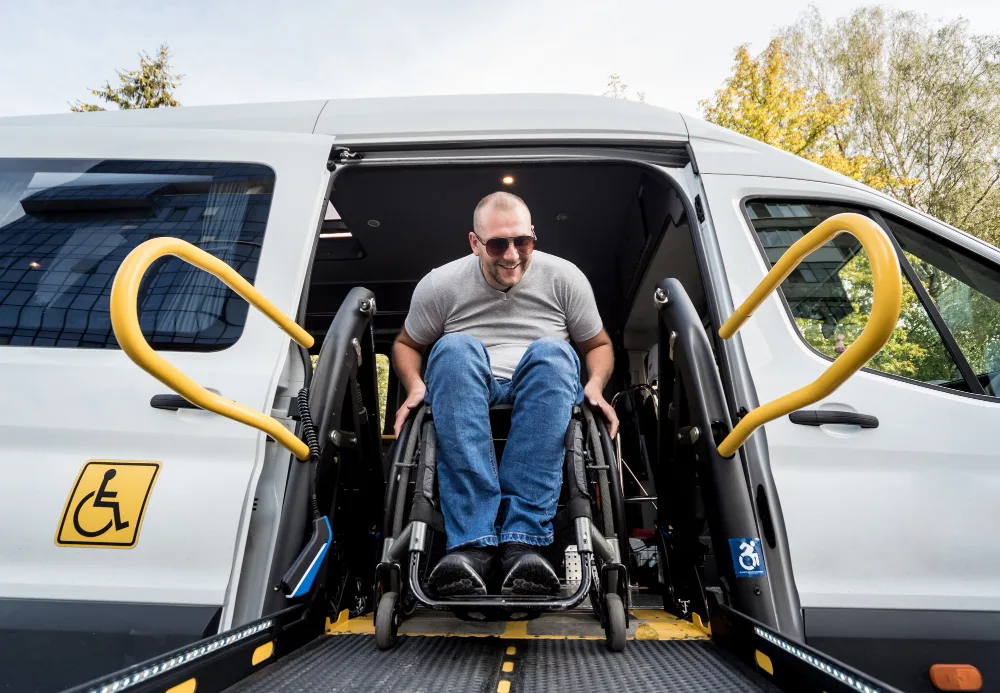
Both drivers and dispatchers may require some training to effectively serve wheelchair customers. Each system listed has some type of driver training and support – ranging from comprehensive to minimal. Operators can also access reliable support for the sometimes complicated mechanical and securement equipment. A presentation on how the local system made the three most responsible parties (the operator, the independent drivers, and the dispatch operator) work together reached an audience of taxi company owners and drivers, a statewide association of taxi and limousine owners, local police and fire departments, the local emergency medical team, hotels, state and local officials, the local board, and the head of national dispatch services.